
General AI & Scripture
Can I use ChatGPT for Bible study?
Yes — as a study aid you verify, not as a teacher, commentary, or spiritual authority. ChatGPT can help you locate a passage, outline a chapter, or compare familiar viewpoints. It can also invent verses, mis-cite references, flatten disagreement, and sound certain when it is wrong. OpenAI has said it can hallucinate, including fabricated citations. Keep a Bible open, separate Scripture from the explanation, and bring weighty questions to accountable people in the church.
The direct answer
Can I use ChatGPT for Bible study?
Yes — as a study aid you verify, not as a teacher, commentary, or spiritual authority. ChatGPT can help you locate a passage, outline a chapter, or compare familiar viewpoints. It can also invent verses, mis-cite references, flatten disagreement, and sound certain when it is wrong. OpenAI has said it can hallucinate, including fabricated citations. Keep a Bible open, separate Scripture from the explanation, and bring weighty questions to accountable people in the church.
What ChatGPT can do. Retrieve likely references, summarize a public interpretation, explain an unfamiliar term, and help you form a more precise question.
What ChatGPT cannot do. Guarantee a verse is real, possess the Holy Spirit, know God’s will for you, or become a pastor, commentary series, or church.
Watch · Faith & AI 17
The answer in under a minute.
The question, the short answer, and the Scripture to test it against. Every verse on screen is quoted from the Lumin Translation as it read when the film was made (edition 1.0); the linked passages show the current text.
Read what’s on screen
- The question Can I use ChatGPT for Bible study?
- The short answer Yes, as a study aid I check. Not a teacher. Not a pastor.
- 1. Ask for a named reference. A chat reply is taped in: try Matthew 6:34, “…do not worry about tomorrow…” Matthew 6:34
- 2. Open it. Read around it. The passage opens in Lumin. “They read clearly from the book of God’s law and explained its meaning…” Nehemiah 8:8
- 3. Check every citation. “…daily scrutinizing the scriptures to see whether these things were so.” Acts 17:11
- 4. Bring big questions to people. Small group, Thursday.
- The takeaway Keep the passage closer than the chat.
Up next · Faith & AI 18
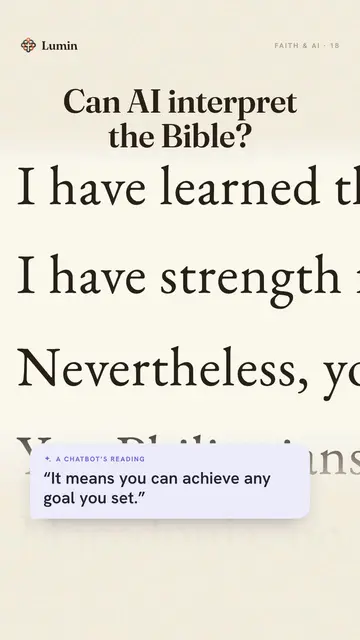 Can AI interpret the Bible?
Start with the product you actually opened
ChatGPT Bible study is still a general assistant, not a Bible.
OpenAI presents ChatGPT as an everyday assistant for writing, search, images, and ordinary questions. It will attempt a Bible answer if you ask. That does not make it a study Bible, a commentary, or a Christian product. It also does not publish a spiritual-authority limit of the kind a church would require of a teacher.
American Bible Society’s 2026 research found that only 14% of Americans agree AI can help them understand the Bible more clearly, while many Scripture-engaged readers already use it for biblical insight. The split is the pastoral reality: people are asking, and most still do not trust the answers. The response is not panic. It is a method for checking.
Six checks for a ChatGPT Bible answer
Keep the passage closer than the chat.
These checks work in ChatGPT, a “Christian GPT,” a search answer, or a video explanation. Confidence is not evidence.
Open the passage yourself.
The Bereans examined the Scriptures to test what they heard. Confirm the quoted words and the reference before you accept the explanation built on them.
Read for sense, not a detached line.
Notice the paragraph, book, genre, speaker, and audience. ChatGPT can paste a verse into a claim its surrounding argument does not support.
Treat uncited certainty as a warning.
OpenAI’s own help materials say ChatGPT can fabricate citations. If you cannot find the verse, the quotation, or the scholar, do not repeat the claim.
Leave room for what is hard.
Some passages are genuinely difficult. Be suspicious when one chat erases Christian disagreement or complexity with a polished paragraph.
Ask for wisdom, not only information.
A summary can supply information. Wisdom also requires prayer, obedience, and discernment about how a truth should be lived.
Do not let a chat become your only church.
Private software is a poor substitute for worship, teaching, correction, and people who can actually know you.
Common ChatGPT Bible-study uses
A method for the questions people already ask.
The same chat can be low-risk exploration or a quiet replacement for Scripture and community. The role you give it matters more than the brand name on the box.
Finding a verse from a remembered phrase
Useful starting point
Search the result in a Bible. Models often produce a plausible reference that is close, merged, or invented.
Outlining a chapter before you read it slowly
Helpful if you then read
Use the outline as a map, then walk the text. Do not let the map replace the territory.
Comparing familiar Christian interpretations
Ask for named sources
“Some scholars say” is not a source. Inspect the tradition or commentator, then return to the passage.
Greek, Hebrew, dates, or historical background
Verify independently
Definitions, morphology, and citations are common hallucination sites. Check a lexicon, translation note, or reputable reference.
Writing a paper, lesson, or small-group guide
Tell the truth about the help
Follow the rules of the class or church. Remain able to explain every claim without the chat open.
“What is God telling me to do?”
The tool is in the wrong role
ChatGPT cannot know God’s private will, receive revelation for you, or replace prayer, conscience, and wise counsel.
If you insist on ChatGPT
A safe pattern: prompts, then the passage.
Prompt listicles own this search. If you will use ChatGPT anyway, borrow their structure — then do what they often skip: open the Bible.
- Ask for a named reference and surrounding context. Refuse to accept a quotation you have not opened.
- Tell the model not to invent verses. When it hedges, treat that as a signal to verify.
- Close the chat and read the chapter yourself before you repeat the claim to anyone else.
What people are doing elsewhere:
Lumin uses the same spine with less risk: a short answer, the verse named, and one next step — then you open the text. See Bible AI and the verification checks on this site.
If the next question is which tool
Verification first. Then an honest jobs split.
Using ChatGPT for Bible study is not automatically wrong. Use the method above, then — if you are choosing a companion rather than a general assistant — see ChatGPT vs Lumin. Soft path to Bible AI and Ask when you want cited Scripture you can open.
Common questions
Plain answers, without invented certainty.
Can I use ChatGPT for Bible study?
Yes, if you treat it as a fallible assistant. Let it help you find, outline, and question. Then open the passage, check every citation, and keep consequential judgment with Scripture, conscience, and the church.
How should I treat ChatGPT Bible study?
Use ChatGPT Bible study as a fallible aid you verify, not as a teacher or spiritual authority. Open the passage, check every citation, and keep consequential judgment with Scripture, conscience, and the church.
Is ChatGPT accurate about the Bible?
Sometimes, and not reliably enough to skip verification. It may summarize a familiar reading well and still invent a verse, scramble a reference, or merge two viewpoints. OpenAI has publicly said it can hallucinate, including fabricated citations.
Is using ChatGPT to study the Bible a sin?
Not inherently. Sin enters through deception, laziness that pretends to be study, or giving a chat the authority of Scripture, the Spirit, or a pastor. An honest, checked use can be permissible.
Does ChatGPT have the Holy Spirit?
No. ChatGPT is human-built software. It can generate language about the Spirit without praying, believing, or speaking for God.
Is there a Christian ChatGPT I should use instead?
A values-filtered or Bible-trained chatbot can still invent citations and occupy the wrong spiritual role. Judge any tool by visible sources, stated limits, and whether it sends you back to the text. See Lumin’s Christian AI and ChatGPT comparison pages.
Can ChatGPT replace a study Bible or commentary?
No. A study Bible and a responsible commentary name translation choices, authors, and methods you can inspect. An unattributed chat synthesis does not.
ChatGPT vs Lumin — which should I use for Bible questions?
Use ChatGPT as a general assistant when the job is not Christian practice. Use Lumin when you want a named verse you can open, a sermon you can carry into the week, and a public limit that AI is not a pastor. They are different jobs.
How should I prompt ChatGPT for a Bible question?
Ask for the reference and the surrounding context, request uncertainty to be named, and refuse to accept a quotation you have not opened. Then close the chat and read.
Your version of the question
Still wondering about your situation? Ask it.
Lumin answers in a few sentences and names the passages it rests on. Each verse it cites is checked and shown in full below the answer, so you can read it yourself.
Keep going
Keep asking in the Lumin app.Keep this conversation going on the web.
The same short answers with the verse beside each one, plus your saved questions, prayer, and the whole Bible to read in.
Make a free Lumin account and this conversation opens in Ask, ready for your next question. Your saved questions, prayer, and the whole Bible come with it.
Sources and further reading
Open the evidence behind the answer.
These sources provide the technical, research, and Christian context used in this guide. The biblical references above should also be read in their full literary and church context.
Vendor documentation
Does ChatGPT tell the truth?
Official help article: ChatGPT can hallucinate and can fabricate citations. It is not a guaranteed source of biblical wording.
OpenAI Help CenterProduct introduction
Introducing ChatGPT
OpenAI’s public introduction states that ChatGPT sometimes writes plausible-sounding but incorrect or nonsensical answers.
OpenAINational research
State of the Bible 2026: AI and Biblical Understanding
A 2026 survey found that only 14% of Americans agree AI can help them understand the Bible more clearly, even as some Scripture-engaged readers already use it for biblical insight.
American Bible SocietyTechnical risk guidance
Generative AI Profile for the AI Risk Management Framework
NIST names confabulation — confident false content — as a core generative-AI risk, which is why a Bible answer must be checked against the text.
National Institute of Standards and Technology