
Worship, music, and artificial intelligence
Is AI worship music bad?
Listening to AI worship music is not a sin. A lyric can be true and a melody can be beautiful whoever arranged it, and God can use a true song to turn a heart toward him. The problems are honesty and worship itself. Presenting an AI singer as a real worship leader with a real testimony deceives listeners. Songs generated for streams at scale can crowd out the church’s songwriters. And a machine cannot worship: it has no spirit to offer God. Sing and listen to what is true, know what you are listening to, and bring your own heart when you sing.
The direct answer
Is AI worship music bad?
Listening to AI worship music is not a sin. A lyric can be true and a melody can be beautiful whoever arranged it, and God can use a true song to turn a heart toward him. The problems are honesty and worship itself. Presenting an AI singer as a real worship leader with a real testimony deceives listeners. Songs generated for streams at scale can crowd out the church’s songwriters. And a machine cannot worship: it has no spirit to offer God. Sing and listen to what is true, know what you are listening to, and bring your own heart when you sing.
What AI can do. Generate melodies, arrangements, backing tracks, and a synthetic voice. Songwriters may use it as a tool, the way they use a drum machine.
What it cannot do. Worship. It has no heart, faith, or testimony. A song credited to an invented worshipper claims something that is not true.
Watch · Faith & AI 42
The answer in under a minute.
The question, the short answer, and the Scripture to test it against. Every verse on screen is quoted from the Lumin Translation as it read when the film was made (edition 1.0); the linked passages show the current text.
Read what’s on screen
- The question Is AI worship music bad? On screen, a music app’s “Top Christian songs” chart: “Glory Rising” by Aria Venholt, tagged AI, climbs from number five to number one.
- The short answer Listening isn’t a sin. A true lyric stays true, whoever arranged it. But only a person can worship.
- Are the words true? The lyrics play: “We sing a new song to You,” “Your word dwells richly in us,” “in spirit and in truth we come.” Each line is checked against Scripture and marked with its passage: Psalm 33:3, Colossians 3:16, John 4:24. “Let Christ’s word dwell richly in you in all wisdom, teaching and admonishing one another with psalms, hymns, and spiritual songs…” Colossians 3:16
- Who is really singing? The artist page shows Aria Venholt, “Verified artist,” with a testimony: “At 19, alone in a hospital chapel, God met me. Every song is my testimony.” The badge flips to “AI-generated,” the story is stamped “Invented,” and the fine print reads “Voice, face, and story: all generated.” “Deceitful lips are an abomination to Yahweh, but those who practice faithfulness are his delight.” Proverbs 12:22
- Is your heart in it? The song’s credits: Vocals, “AI voice model.” Music, “Generated from a prompt.” Lyrics, “Checked against Scripture.” Worship, “Not included.” “…this people draws near to me with their mouth and their lips to honor me, but they have distanced their heart far from me…” Isaiah 29:13
- Let the words be true. Let the heart be yours. The camera pulls back from the phone to a sunlit kitchen. The same song plays from the windowsill while a mother and her child sing along, eyes closed, music notes rising. “God is spirit, and those worshiping him must worship in spirit and truth.” John 4:24
Up next · Faith & AI 43
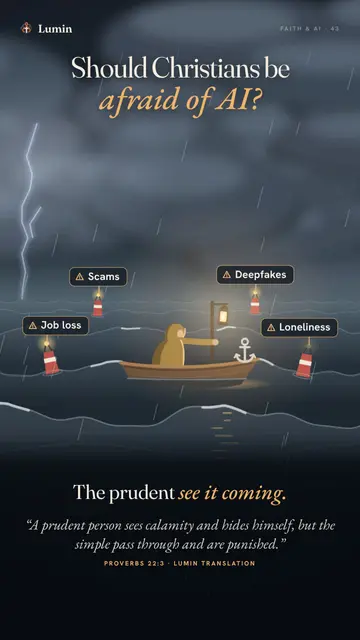 Should Christians be afraid of AI?
The older question
In spirit and truth: two tests for any song.
John 4:24 in the Lumin Translation: “God is spirit, and the ones who worship him must do so in spirit and truth.” Jesus gives two tests. Truth is about what the song says: is it faithful to who God is? Spirit is about the worshipper: is a heart actually turned to God? An AI-generated song can pass the first test. Only a person can pass the second, and that person is you, singing along.
In November 2025, an AI-generated gospel act called Solomon Ray reached number one on the iTunes Christian charts. Christianity Today reported the debate: worship leader Forrest Frank objected that AI does not have the Holy Spirit inside of it, while the creator defended it as a way to spread the gospel. A real worship leader named Solomon Ray found friends asking about songs he had not made. The questions it raised are the right ones: who is singing, who is being honored, and whether listeners were told the truth.
What Scripture weighs
True words, real hearts, honest labels.
These passages speak to any worship music, with or without AI.
In spirit and truth.
Test the lyrics for truth. Then remember the worship itself happens in the singer, not the file.
Lips near, heart far.
God rebukes worship that is only words. A flawless AI track can be sung with a distant heart, and so can a hymn. Bring your heart.
Songs are for teaching one another.
Paul describes singing as the church teaching and admonishing itself. Songs carry doctrine, so their words matter more than their source.
Play it well.
Skill in worship is good. Tools that help musicians play and write well can serve that, as instruments always have.
Deal truthfully.
An AI singer marketed with an invented life story and testimony misleads the people it asks to trust it.
The worker deserves wages.
The church’s songwriters and musicians are workers. Choosing to support them is a way to love neighbors.
Real situations
From your playlist to Sunday morning.
The answer shifts depending on who made it, how it is presented, and how it is used.
You enjoyed an AI worship song before you knew it was AI
No sin
If the lyrics are true and your heart was toward God, your worship was real. Now you know what it is, and can choose.
An AI artist is presented as a real person with a testimony
Deceptive
Listeners are being asked to trust a story that is not true. That is a reason to be cautious about supporting it.
A songwriter uses AI to sketch a melody, then writes and sings it themselves
A tool, like any other
Instruments, recording software, and drum machines are tools too. The worshipper and writer are still the person.
A church uses AI-generated songs in the service
Ask what it teaches your people
Check the words as carefully as any song, be open about the source, and weigh what it means for your own musicians.
Listening to AI worship music in the car or at work
Your freedom, use it wisely
Choose songs that say true things about God. Keep singing with real people on Sunday too.
Using AI to generate a song in a real worship leader’s voice
Do not
Cloning a person’s voice without consent is deceptive and takes what is theirs.
Common questions
Plain answers, without invented certainty.
Is AI worship music bad?
Not in itself. A true lyric can help you worship whoever arranged it. The concerns are deception about who is singing, crowding out real songwriters, and forgetting that only people can worship.
Is listening to AI gospel music a sin?
No. Listening to a song with true words is not a sin. Know what you are listening to, and support honest artists where you can.
Is AI Christian music good?
Some of it has true words and good melodies. Judge it like any song: is it true about God, does it help you worship, and is it honest about how it was made?
Can AI worship God?
No. Worship is a person turning heart and life toward God in spirit and truth. A machine can produce sound. It cannot offer praise.
Who is Solomon Ray?
An AI-generated gospel act that reached number one on the iTunes Christian charts in November 2025, prompting debate among Christian artists. A real worship leader shares the name.
Should churches use AI worship songs?
That is a decision for church leaders. Check the lyrics like any song, be open with the congregation, and weigh the value of songs written and led by your own people.
Is it okay to use AI to write worship songs?
As a tool, yes, like any instrument or software. Be honest about it. The songwriter is still responsible for every word the church will sing.
Can AI lead worship?
No. Leading worship is a pastoral act by a person who worships. The guide on AI and worship leading explains the difference.
Your version of the question
Still wondering about your situation? Ask it.
Lumin answers in a few sentences and names the passages it rests on. Each verse it cites is checked and shown in full below the answer, so you can read it yourself.
Keep going
Keep asking in the Lumin app.Keep this conversation going on the web.
The same short answers with the verse beside each one, plus your saved questions, prayer, and the whole Bible to read in.
Make a free Lumin account and this conversation opens in Ask, ready for your next question. Your saved questions, prayer, and the whole Bible come with it.
Sources and further reading
Open the evidence behind the answer.
These sources provide the technical, research, and Christian context used in this guide. The biblical references above should also be read in their full literary and church context.
Christian journalism
The Current No. 1 Christian Artist Has No Soul
Kelsey Kramer McGinnis reports on the AI act Solomon Ray topping Christian charts, objections from artists including Forrest Frank, and the creator’s defense.
Christianity TodayEvangelical ministry statement
Brentwood Statement on Artificial Intelligence and Christian Ministry
A June 2026 statement from Southern Baptist leaders on wisdom, human dignity, truthfulness, trust, privacy, and faithful leadership in ministry use of AI.
Lifeway Christian Resources and Southern Baptist leadersChristian ethical reflection
When creation creates technology
ERLC research on the creation mandate, human stewardship, and why artificial intelligence remains a human-made tool—not a moral agent.
Ethics & Religious Liberty CommissionEditorial theology
Christians Can Give Two Cheers for AI
TGC argues for hopeful realism: AI reflects human creativity under the creation mandate but cannot receive the wisdom or moral weight that belong to God.
The Gospel CoalitionChristian ethical reflection
Antiqua et nova: Artificial Intelligence and Human Intelligence
The Vatican’s 2025 note distinguishes functional machine output from embodied, relational human intelligence. Lumin cites it as one Christian contribution, not a universal denominational statement.
Dicasteries for the Doctrine of the Faith and for Culture and EducationEditorial theology
When We Make Intelligence in Our Image
Christianity Today on the creation mandate, human personhood, and welcoming AI as human creativity without anthropomorphizing or idolizing it.
Christianity Today