
Creativity, images, and artificial intelligence
Is AI art a sin?
No—not by itself. Making an image with AI is not a sin. The moral questions sit around it: whether you are honest about how it was made, whether you treat human artists fairly, whether a realistic image deceives, and how you depict God. Christians differ about images of Christ, so AI images of Jesus call for more care, not less. Use the tool honestly, credit and pay human artists where you can, and never pass a generated image off as a real photograph or as the work of your own hand.
The direct answer
Is AI art a sin?
No—not by itself. Making an image with AI is not a sin. The moral questions sit around it: whether you are honest about how it was made, whether you treat human artists fairly, whether a realistic image deceives, and how you depict God. Christians differ about images of Christ, so AI images of Jesus call for more care, not less. Use the tool honestly, credit and pay human artists where you can, and never pass a generated image off as a real photograph or as the work of your own hand.
Where it is usually fine. Sketching ideas, making a birthday card, drafting a slide background, or exploring a concept you will refine. Honest use of a tool is not a sin.
Where it goes wrong. Passing generated work off as handmade, faking photographs of real people or events, copying a living artist’s style to undercut them, or making sacred images carelessly.
Watch · Faith & AI 26
The answer in under a minute.
The question, the short answer, and the Scripture to test it against. Every verse on screen is quoted from the Lumin Translation as it read when the film was made (edition 1.0); the linked passages show the current text.
Read what’s on screen
- The question Is AI art a sin? The same valley at sunrise, twice: one painted stroke by stroke, one generated from the prompt “a valley at sunrise, oil painting.”
- The short answer Not by itself. The questions sit around it: honesty, fairness to artists, real people, and how we picture God.
- Tell the truth about the tool. The gallery label “Oil on canvas” is struck and corrected to “AI image, made with a prompt.” “Deceitful lips are an abomination to Yahweh, but those who practice faithfulness are his delight.” Proverbs 12:22
- Honor the hands. “…I have filled him with the Spirit of God, in wisdom, understanding, knowledge, and all workmanship.” Exodus 31:3
- Don’t fake a real person. A realistic image of a real person, doing what they never did: don’t make it, don’t share it. “You shall not testify against your neighbor as a false witness.” Exodus 20:16
- Pay the worker. A prompt asks for a church poster “in the style of [a living artist].” Hire them instead. “…the worker deserves his wages.” Luke 10:7
- Make what is true and lovely. “…whatever is true, whatever honorable, whatever just, whatever pure, whatever lovely…” Philippians 4:8
- The takeaway The picture isn’t the sin. A false label would be.
Up next · Faith & AI 27
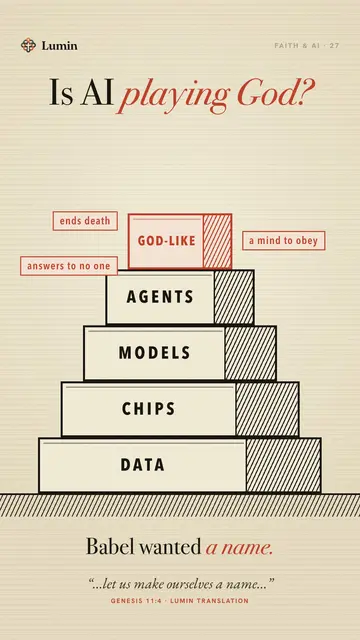 Is AI playing God?
Skill is a gift
God fills makers with skill for beautiful work.
Exodus 31:3 in the Lumin Translation: “I have filled him with the Spirit of God, with skill, understanding, and knowledge in every kind of craft,” God says this of Bezalel, the artisan he called to make the tabernacle beautiful. Human making is part of bearing God’s image. So Christians should neither panic at a new creative tool nor shrug at what it might crowd out. Craft, patience, and the person behind the work matter to God.
The hard questions are specific. Image generators learned from vast collections of human-made pictures, often without their makers’ permission, and working artists have lost commissions to them. Realistic images can show events that never happened. Images of Jesus have divided Christians for centuries: Catholic and Orthodox Christians honor sacred images, while some Reformed traditions teach that the second commandment forbids any picture of Christ. Writing for Word on Fire, Steven Umbrello argues that AI cannot make true sacred art, because such art comes from a person’s own engagement with the mysteries of faith. You do not have to settle every debate to act faithfully today.
Six questions for any image
Judge the use, the claim, and the people involved.
None of these passages mentions software. Each names something a generated image can honor or violate.
Is craft being honored?
God filled Bezalel with skill for beautiful work. A tool can serve craft; it should not teach you to despise the patience craft takes.
Am I telling the truth about it?
Do not present a generated image as your own handwork or as a photograph of something that happened. Label it plainly when anyone could be misled.
Could it deceive about a real person?
A fake image of a real person saying or doing something is false witness in picture form. Do not make it, and do not share it.
Am I treating artists fairly?
The worker deserves wages. If your church or business can hire an artist, a free generator is not an automatic excuse not to. Do not imitate a living artist’s style to replace them.
Am I depicting God with reverence?
Christians read this command differently, but all agree God is not a prop. Images of Christ call for reverence, painted or generated, and some believers will not use them at all.
Is it true, honorable, and lovely?
Ask what the image trains the eye to love. Beauty that serves truth is worth making. Pious clickbait and shock images are not.
Common situations
Most uses are ordinary. A few are not.
Rules from a client, school, publisher, or platform matter. Within them, these are sound starting judgments.
A card, a slide background, or a mockup for yourself or a small group
Usually fine
Be honest if anyone asks how it was made, and follow the tool’s license.
Entering a generated image in an art contest or selling it as your painting
Wrong when it deceives
If people believe your hand made it, concealment turns a tool into a lie. Disclose it, or do not enter.
Church graphics for a sermon series
Permissible—weigh the people
Say how it was made if that matters in your setting. If a gifted artist sits in your pews, consider asking them first.
Generating images of Jesus or scenes from Scripture
Christians differ; take care
Some traditions welcome sacred images and some forbid them. Avoid glamorized or engagement-bait portraits, and do not let a generated face become the Christ people picture.
A realistic image of a real person or a news event that never happened
Do not make or share it
That is deception, even as a joke that might travel. False witness has always included pictures.
Prompting “in the style of” a living artist to avoid paying them
Unloving to a neighbor
Even where it is legal, it takes the fruit of someone’s labor to undercut them. Hire them, or find another way.
Common questions
Plain answers, without invented certainty.
Is AI art a sin?
Not by itself. Scripture does not forbid using tools to make images. Sin enters through deception, unfairness to artists, false images of real people, or careless images of God.
Is it a sin to make AI images of Jesus?
Christians disagree about any images of Christ. Catholic and Orthodox Christians honor sacred images, while some Reformed Christians believe the second commandment forbids them. If your tradition allows images, make and use them with reverence and honesty, and avoid glamorized or engagement-bait portraits.
Is AI art stealing?
Christians and courts are still weighing how image generators were trained. What is clear is how to treat people now: do not copy a living artist’s style to replace them, respect licenses, and pay artists when you can.
Can churches use AI-generated images?
Yes, with care. Be honest about how images were made when it matters, avoid fake photographs, and consider commissioning artists in your congregation. Treat images of God and of Christ with reverence.
Is it wrong to sell AI art?
Not inherently, if you are honest about how it was made and you follow the tool’s license and the platform’s rules. Presenting it as hand-painted or as a photograph is deception.
Is AI art real art?
People disagree. Christians can say this much: human creativity reflects the image of God, and a person who uses a tool is still responsible for what they make. Some argue AI cannot make true sacred art because it has no faith of its own.
What about AI music and writing?
The same questions apply: tell the truth about how it was made, respect other people’s work, and stay responsible for what you publish. Songs for worship raise more questions; the guide on whether AI can lead worship covers them.
Your version of the question
Still wondering about your situation? Ask it.
Lumin answers in a few sentences and names the passages it rests on. Each verse it cites is checked and shown in full below the answer, so you can read it yourself.
Keep going
Keep asking in the Lumin app.Keep this conversation going on the web.
The same short answers with the verse beside each one, plus your saved questions, prayer, and the whole Bible to read in.
Make a free Lumin account and this conversation opens in Ask, ready for your next question. Your saved questions, prayer, and the whole Bible come with it.
Sources and further reading
Open the evidence behind the answer.
These sources provide the technical, research, and Christian context used in this guide. The biblical references above should also be read in their full literary and church context.
Christian ethical reflection
Sacred Art or Synthetic Imitation? The Catholic Challenge to AI-Driven Creations
Steven Umbrello argues that AI can serve evangelization but cannot make true sacred art, which comes from a person’s own engagement with the mysteries of faith.
Word on FireEvangelical ministry statement
Brentwood Statement on Artificial Intelligence and Christian Ministry
A June 2026 statement from Southern Baptist leaders on wisdom, human dignity, truthfulness, trust, privacy, and faithful leadership in ministry use of AI.
Lifeway Christian Resources and Southern Baptist leadersChristian ethical reflection
When creation creates technology
ERLC research on the creation mandate, human stewardship, and why artificial intelligence remains a human-made tool—not a moral agent.
Ethics & Religious Liberty CommissionEditorial theology
Christians Can Give Two Cheers for AI
TGC argues for hopeful realism: AI reflects human creativity under the creation mandate but cannot receive the wisdom or moral weight that belong to God.
The Gospel CoalitionChristian ethical reflection
Antiqua et nova: Artificial Intelligence and Human Intelligence
The Vatican’s 2025 note distinguishes functional machine output from embodied, relational human intelligence. Lumin cites it as one Christian contribution, not a universal denominational statement.
Dicasteries for the Doctrine of the Faith and for Culture and EducationEditorial theology
When We Make Intelligence in Our Image
Christianity Today on the creation mandate, human personhood, and welcoming AI as human creativity without anthropomorphizing or idolizing it.
Christianity Today