
Discernment for a skeptical church
Can I trust Christian AI?
Trust Christian AI only as a tool. It can help you find a passage, organize a sermon, or name a question. It cannot become Scripture, the Holy Spirit, your pastor, or the church. Before you give any product a place in study or prayer, look for named verses you can open, plain limits, a human who will own a mistake, and no voice that pretends to be Jesus. Lumin publishes those limits in the Covenant. AI remains fallible even when the verses are real.
The direct answer
Can I trust Christian AI?
Trust Christian AI only as a tool. It can help you find a passage, organize a sermon, or name a question. It cannot become Scripture, the Holy Spirit, your pastor, or the church. Before you give any product a place in study or prayer, look for named verses you can open, plain limits, a human who will own a mistake, and no voice that pretends to be Jesus. Lumin publishes those limits in the Covenant. AI remains fallible even when the verses are real.
What a tool can earn. Help finding a passage, a short cited answer, sermon notes you can return to, and prayer prompts you still pray. Each of those stays under Scripture and under people who know you.
What a tool cannot earn. Spiritual office. Inerrancy. The right to speak as Jesus, God, a prophet, or a pastor. The right to replace your church. Fluency is not faithfulness.
Watch · Faith & AI 14
The answer in under a minute.
The question, the short answer, and the Scripture to test it against. Every verse on screen is quoted from the Lumin Translation as it read when the film was made (edition 1.0); the linked passages show the current text.
Read what’s on screen
- The question Can I trust Christian AI? Read the label: Trust Facts, serving size one Christian AI app.
- The short answer Only as a tool. Not as Scripture, the Holy Spirit, your pastor, or the church.
- Required: verses you can open “…daily scrutinizing the scriptures to see whether these things were so.” Acts 17:11
- Required: limits in plain words and an app that admits when it isn’t sure Plain limits, and plain uncertainty.
- Required: a named person who owns mistakes “…do not many of you become teachers, knowing that we will receive greater judgment.” James 3:1
- Should read 0% Speaks as Jesus. Hidden sources. Streaks and guilt trips. Spiritual authority. “…do not believe every spirit, but examine the spirits whether they are from God…” 1 John 4:1
- Footnote “Examine all things, but keep the good.” 1 Thessalonians 5:21
- The takeaway Give the tool a job. Not an office. Lumin publishes its limits in the Lumin Covenant.
Up next · Faith & AI 15
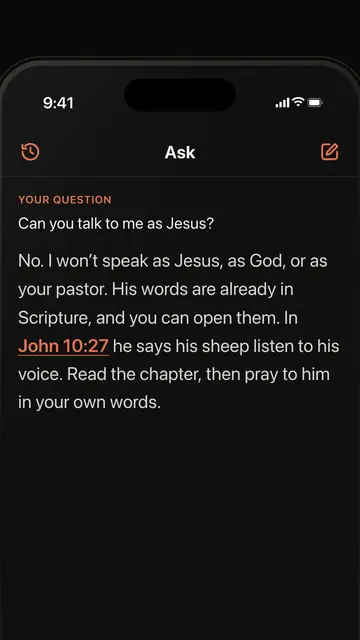 Does Lumin speak as Jesus?
Why distrust is reasonable
Christians have already seen the failure modes.
People have been shown invented verses, buried disclaimers, streak-shaming, and chatbots that speak as Jesus until a FAQ later says the character is not real. Distrust here is not Luddism. It is a refusal to give a machine the place that belongs to the Word and to the people of God.
The test is concrete. Can you open the named passage? Does the product admit uncertainty? Is a named person accountable when the copy is wrong? Does it refuse to impersonate Christ? Lumin’s answer is public: the Covenant, the citation method on the About page, and a free Bible reader where you can open any chapter yourself instead of taking a summary on faith.
A short inspection
Inspect the tool the way you would inspect a study aid.
These are not anti-technology verses. They describe how Christians already test teaching, spirits, and tools.
Open the passage.
The Bereans examined the Scriptures daily to see whether the teaching was so. A Christian AI that will not show you the verse has already failed the first test.
Test the spirits — including the confident ones.
Not every religious-sounding sentence is from God. A model that cannot be questioned, or that hides its sources, is asking for a trust it has not earned.
Scripture remains the authority.
The church is equipped by God-breathed Scripture, not by generated paraphrase. A gloss can help you start. It cannot become the canon.
Teachers are judged more strictly.
Software does not stand in that office. If a product talks like a teacher of the church, ask who will give account when the counsel harms.
The first to speak sounds right.
A fluent first answer is still a first answer. The second look is the verse in context, and often a person who knows you.
Test everything. Hold fast what is good.
Permission to use a tool is not a command to believe it. Keep what is true after you have checked it. Discard the rest.
Where trust belongs — and where it does not
Give the tool a job. Do not give it an office.
The question is not whether AI exists. The question is what place you give it on a Tuesday night.
Checking a citation from a Christian AI reply
This is the right use
Open the named chapter. If the summary and the text disagree, trust the text. Lumin is built for that check.
Letting a chatbot speak as Jesus or as “a word from the Lord”
Do not do it
That is not a Bible study aid. It is impersonation. Lumin refuses that office.
Replacing your pastor or small group with a private model
The tool is in the wrong role
A model cannot know you, visit you, baptize you, or answer for its advice. Take the question to people.
Using AI when you cannot sleep and need a verse
A starting point, not care
Find the passage. For despair, abuse, or crisis, seek a human and real-world help.
A product that hides sources or shames you for leaving
Walk away
Guilt trips and hidden sources are signs a tool has forgotten its place under the Word.
Asking who built the app and who owns a mistake
Ask it out loud
Anonymous spiritual software is harder to correct. Lumin names its founder, Andrew Kittridge.
Common questions
Plain answers, without invented certainty.
Can I trust Christian AI?
Trust it as a fallible tool with verses you can open, not as a pastor or as God. Inspect citations, limits, privacy, and whether it refuses to speak as Jesus. Lumin publishes those limits in the Covenant.
Can I trust Lumin?
You can trust Lumin to cite the passage it draws on, keep your memories under your control, skip the guilt trips, and never claim spiritual authority. You should not treat it as inerrant. Open the verse. Keep the last word with Scripture and the people who know you.
How can I tell whether a Christian AI tool is trustworthy?
Named verses you can open. Plain uncertainty. A named person accountable for the copy. Privacy and deletion you can use. No streak shaming. No voice of Jesus. If those are missing, the distrust is earned.
Is Christian AI safe for Bible study?
It can be a study aid if you verify every citation and keep the chapter in view. It is not safe as a final interpreter. “Can AI interpret the Bible?” goes deeper.
Does Lumin invent Bible verses?
Lumin is built so answers name Scripture you can compare with the text. AI can still mishandle a citation. Treat every generated explanation as help to check, not a final word. The About page explains how Lumin cites Scripture.
Should Christians use AI at all?
They may, with discernment. The moral question is what place you give it. “Should Christians use AI?” walks through that question.
Where are Lumin’s limits written down?
In the Lumin Covenant. The About page explains how Lumin cites Scripture, and the FAQ covers the product. All three are public on purpose.
Your version of the question
Still wondering about your situation? Ask it.
Lumin answers in a few sentences and names the passages it rests on. Each verse it cites is checked and shown in full below the answer, so you can read it yourself.
Keep going
Keep asking in the Lumin app.Keep this conversation going on the web.
The same short answers with the verse beside each one, plus your saved questions, prayer, and the whole Bible to read in.
Make a free Lumin account and this conversation opens in Ask, ready for your next question. Your saved questions, prayer, and the whole Bible come with it.
Sources and further reading
Open the evidence behind the answer.
These sources provide the technical, research, and Christian context used in this guide. The biblical references above should also be read in their full literary and church context.
Published product commitments
The Lumin Covenant
Public limits: checkable Scripture, memory you control, no guilt hooks, and no spiritual office for the model.
LuminChristian ethical reflection
Antiqua et nova: Artificial Intelligence and Human Intelligence
A Catholic source distinguishing functional machine output from embodied, relational, moral human intelligence. Cited as one Christian contribution, not as Lumin’s denomination.
Dicasteries for the Doctrine of the Faith and for Culture and Education